

To a prosthetist, the approach to creating a transfemoral, or above knee (A/K), replacement limb can be considerably different than for a lower amputation level. Where a transtibial (B/K) prosthesis must replace the foot, ankle and part of the lower leg, an above-knee system adds the critical knee joint and part of the femur…and the degree of difficulty jumps exponentially.
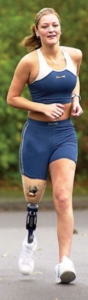 Fortunately, surgeons have become quite good at predicting the level at which amputation wound healing will be successful, reducing the number of unnecessarily high amputations. Still, nearly 20 percent of all individuals with limb loss in the U.S. have a transfemoral deficiency, and an estimated 29,000+ above-knee amputations are performed in this country annually.
For patients, an A/K prosthesis presents a much greater challenge than a B/K system, in terms of weight, energy expenditure, balance, safety, comfort, and functional mastery. Thus, we select and recommend particular components and materials that will help transfemoral amputees achieve their maximum possible rehabilitation outcome. The process of accomplishing this outcome is as much art as science.
Ideally, prosthetic management involves the active participation of the patient’s physician, amputating surgeon, family and physical therapist. Interviewing patient and family before surgery can give us a head start on planning a new amputee’s course of treatment and prosthesis design. Our three main questions:
- What can the patient physically—and mentally—do?
- How much residual limb do we have to work with?
- What are the patient’s mobility and lifestyle desires?
Surgical Considerations For A Prosthetic Limb
The adage prosthetic success begins in the O.R. is quite apropos for a tramsfemoral amputation. Particular issues at this level are (1) the inability of the residual femur to tolerate virtually any end-bearing load and (2) muscle imbalance resulting from severed adductors and extensors leading to abnormal outward leg swing during prosthetic gait.
 When it is practicable for surgeons to restore balance through myodesis reconstruction of these muscles, the residual limb can be restored to a more balanced natural position in which weight bearing can be directed to the side of the residual limb. Moreover, myodesis helps keep the femur centered in the muscle mass, facilitating socket comfort.
In lieu of or in combination with myodesis, a myoplasty reconstruction may also enhance the prosthetic outcome. While aggressive post-operative management with an IPOP (immediate postoperative prosthesis) is common for transtibial amputees, it is less frequently used for above-knee patients. The benefits of early ambulation must be weighed against the patient’s ability to tolerate a non-removable rigid cast incorporating the pelvic area. In the absence of an IPOP, the post-operative focus is on wound healing and protection and prevention of hip contractures
When the patient is deemed ready for a replacement limb, a preparatory prosthesis consisting of a check socket and knee and foot components may be prescribed to assess socket and component function before proceeding with the finished system.
Ability Considerations
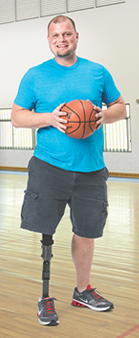 While we would like for every amputee to be able to walk again with a prosthetic limb, the reality is that a fair number lack the physical strength, coordination, mental ability and/or will to do so. The percentage of non-ambulators increases directly with amputation level.
Absent a natural knee joint, the challenge becomes significantly greater for an A/K patient. To rise from a sitting position or vice-versa, an above-knee amputee must possess a good measure of strength and coordination in the remaining lower limb, arms, shoulders and torso. The less strength and coordination, the greater chance of a fall. Thus, we evaluate each new patient’s condition, abilities and functional desires before developing a management plan and goals in conjunction with the patient, family, and others on the rehab team.
Prosthetic Componentry
A prosthetic limb is in fact a system incorporating various essential designs and components, each with its own specialized function. For each able above knee amputee entrusted to our care, our prosthetic staff creates an individualized leg incorporating the best combination of socket design, suspension scheme, knee and ankle-foot components for that patient’s capabilities and functional desires.
 Socket Designs—While all aspects of a transfemoral prosthesis are important, patient surveys reveal that the fit and comfort of the socket are by far the most critical considerations for a successful outcome.
Today’s sockets typically employ some variety of an ischial containment (I.C.) design, which has largely replaced the long-popular quadrilateral (quad) shape. I.C. sockets feature a narrow medial-lateral dimension with the ischium encapsulated within the socket instead of sitting on the brim. Some I.C. socket proponents contend the design helps maintain the residual limb in an anatomically normal adducted position, solving the common side lurch gait resulting from the replacement limb migrating outward during swing phase.
Quad sockets are still applicable for various patients, both for a preparatory prosthesis and as the socket of choice for individuals who have worn a quad for many years and have no wish to change.
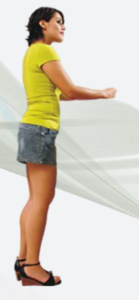
 A unique I.C. design, the Marlo Anatomical Socket® (MAS), resulted from an effort to eliminate the posterior socket brim outline clearly visible under the clothing of female A/K amputees. Beyond that cosmetic goal, the MAS also provides increased range of hip motion and is comfortable to wear when standing, walking and sitting down. The MAS features a low posterior brim and pronounced medial alignment that facilitates a more normal and energy-efficient gait. This socket is still relatively new, and the design continues to evolve.
Today’s transfemoral socket construction is trending to flexible yet durable plastics, which provide rigid support where needed while still allowing for muscle motion. A flexible wall socket consists of an elastic inner socket within a rigid outer frame with open spaces, providing a comfortable interface with the residual limb at less weight.
Suspension—Almost as important as socket fit is the suspension method, i.e. how the prosthesis is attached to the body. A good suspension maintains the socket in snug contact with the residual limb and prevents undesirable sliding, rotation and/or pistoning movement within the socket.
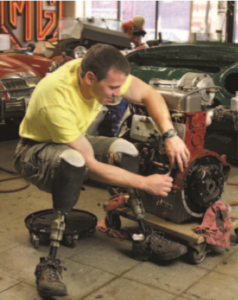 Several suspension options are available:
- Total contact pure suction using an expulsion valve, which allows air to escape from the socket as the residual limb is inserted, creating a vacuum within the socket.
- Roll-on gel liner fitted with a locking pin, lanyard or strap-and-buckle-type attachment device.
- Soft straps or waist belts (TES belt, Silesian band).
- Rigid belt with hip hinge.
Each of these methods works better for some patients than others. Roll-on liners with a locking pin have become widely used in recent years; however, this method concentrates significant force at the distal end of the residual limb, which some patients cannot tolerate. Alternative locking methods, e.g. a lanyard or buckles, can be an effective alternative.
Pure suction, while difficult to achieve for some amputees, often works when a locking liner will not. Soft suspension belts and rigid belts with hip hinges are sometimes prescribed for patients who need a high sense of security that their suspension will hold. Soft belts are often used with a preparatory transfemoral system when residual limb changes preclude suction suspension.
Prosthetic Knees – Selecting the most appropriate knee component involves careful weighing of the amputee’s overall health and capabilities, predicted type and intensity of prosthetic use, and cost. We choose from among several basic types:
- A manual locking knee is locked for ambulation, unlocked for sitting. The amputee walks stiff-legged and must swing the leg outward for floor clearance, which is both awkward and energy-consuming. However, this is the most stable choice and is appropriate for limited ambulators.
- Constant friction knees are simple, lightweight and dependable, but they limit the wearer to a single cadence. The friction setting determines the speed of leg swing and is adjusted for the patient’s normal walking speed.
- Stance-control, or “safety,” knees incorporate a weight-activated brake that prevents knee buckling while in stance phase. This knee is often prescribed for a new amputee’s first prosthesis.
- Polycentric knees provide a moving center of rotation keyed to the degree of knee flexion and thus help ensure swing phase floor clearance for patients with a long residual femur or knee disarticulation.
- Hydraulic and pneumatic knee systems are appropriate for patients capable of variable cadence. These designs immediately match leg swing to walking speed so the amputee can confidently change cadence, walk on slopes and ambulate in a step-over-step fashion.
- Microprocessor-controlled knee units, such as the C-Leg® or Rheo Knee, constantly monitor cadence parameters and make instantaneous adjustments to knee function to provide an extremely natural and efficient gait. As the most technologically advanced option, these knees are not surprisingly the most costly. Increasing numbers of patients, however, are judging the results they provide to be well worth the expense. One notable outcome is that many amputees wearing a computerized knee system gain such confidence in their gait that they no longer have to think about each step, thereby gaining more stamina through reduced mental energy expenditure.
 Ankle-Foot Components – It comes as a surprise to many that the type of prosthetic foot that works for a transtibial amputee may not be best for an above-knee patient. Transfemoral amputees feel more secure when their prosthetic foot is flat on the ground; thus, the dynamic response feet so popular for transtibial applications are not as desirable for A/K patients, as their stiffness can delay full ground contact.
What does work well in many cases is a single-axis or multi-axis foot, which achieves foot-flat almost immediately after heel strike. Multi-axis feet are particularly good for patients whose activities include walking on uneven terrain, although they tend to weigh more than other foot choices.
Prosthetic Alignment
When the building blocks of the transfemoral limb are selected and ready for assembly, the art of prosthetics again comes to the fore. Optimal alignment of the various components when creating the finished prosthesis can make all the difference between a great outcome and a poor one. The alignment process balances safety and stability with an efficient, comfortable gait.
Technology has provided us with wonderful prosthetic designs and products. Our mission is to select and assemble them such that the finished limb is far greater than the sum of the parts and our patient realizes his or her full potential.
Please call LeTourneau & Family Orthotics and Prosthetics for your free consultation. Our offices are located in Beaumont, Nederland and Jasper, Texas.